Logan’s two stories “Half-Life” and “Ciret Street” will be published in the 2024 issue of HIKA. “Ciret Street” previously appeared in HIKA Fall preview.
There are five of you [five of us], five cousins, a set of three and a set of two, placed carefully in the guest bedroom like books on a shelf. You’re in your proper place, between two of your cousins so they won’t fight, so they won’t argue, so their words don’t fill the morning air with rotten fruit. Sour. Sticky. But you don’t have to worry about that now because their heads rest easily on the pillows and their breathing is even.
— from “Half-Life”
How did you get into writing?
I’ve been writing for — I know it’s a cliche — but for as long as I can remember. I read a lot when I was a kid. Both of my parents work in education and have been [working in education] since they graduated. So my siblings and I grew up around a lot of books. We read a lot; we were read to a lot. In our family, that’s also a way of passing down history — through oral storytelling. So I’ve always been surrounded by [literature]. It was almost natural to just continue that in some way, so since I was really really little, I’ve been making stuff up,
Were there any specific works that were particularly influential to you?
There’s a children’s book called The Dot by Peter H. Reynolds. It’s one of my favorite books to this day, even though it is a children’s book. It’s basically about this little girl who feels like she doesn’t know how to draw, and her teacher says that just make a mark and see where it takes you. So she makes a dot with a pencil, and it turns into this whole thing where she’s painting these giant dots and using different materials to meet dots. That was one of my favorite stories when I was a kid. That was a big one.
And Coraline — that was another one of my favorite childhood books. The Hobbit, The Lord of the Rings — I loved those when I was little. Other children’s books: Toot & Puddle, Stellaluna, Frog and Toad. I love Frog and Toad. But yeah, The Dot was a big one for me.
What inspired you to write “Half-Life” and “Ciret Street”?
In my AP Lang course, we read Citizen by Claudia Rankine. The things we were thinking about when looking at that book were the style of writing and how individual moments are pieced together.
So I was thinking about that when I wrote Half-Life. And I was thinking about when my cousins and I were very little, we used to stay at our grandparents’ house. The only CD they had was Michael Jackson’s “Thriller” music video on DVD. We would watch that all the time. And one of my cousins, every night without fail, would just pretend to turn into a werewolf. Because in the music video, Michael Jackson turned into a werewolf, his response was, I’m gonna scare Logan and pretend in the middle of the night to turn into a werewolf. So that was what I was thinking about when I wrote “Half-Life.”
“Ciret Street” is entirely fiction. Half-Life is creative non-fiction. I think a lot about ghosts when I write. That was a big part of what I was thinking about with “Ciret Street.” I remember when I started writing it, the opening line came to me first — this idea of people hanging from the trees like fruits. That really stuck with me, so I was like, This might be something; this might not be; let’s see. That’s how my writing starts: There’s a line here. Let’s see where this goes.
My grandmother gave birth to her children in a land where men hung from the trees like fruit, heavy and ripe for the picking.
— from “Ciret Street”
Children know as children do that child-sized things—toys, clothes, bones—have a natural life that always ends, and it might as well end with rot, the kind that bedtime prayers can’t remove.
— from “Half-Life”
That’s what I was going to ask about. Both pieces start with a banger of an opening line, which made me curious about your writing process. Are you more of a planner, or like The Dot, you start somewhere and see where it takes you?
I’m not a planner. I really should be. I mean, there are all sorts of ways to write. And I’ve tried a lot of different writing styles over the years and a lot of different processes, whether that’s making an outline. I try to [outine] when I write longer form stuff. That never really happens with short stories. Like “Ciret Street,” I had that one line, and I just played around with it, wrote it a bunch of different times. I handwrite all my short stories when I’m working on them. Usually when I’m thinking of a short story, a line will come to me first, and then throughout the day, or throughout the week, or month, or however long I’m thinking about it, other lines will just start coming to me as I’m [doing some other things such as] walking around or [taking] Latin.
I find [that writing is] like puzzle pieces — just gathering a bunch of stuff that sometimes fits together. Sometimes you have to throw something out. But for “Ciret Street,” I remember I had that first line, and I wrote it out [into] two similar stories but with slight differences, and then I went with the one that I liked best.
Can you tell me more about the two versions of “Ciret Street”?
I have one that is [the version published on HIKA]. And then I had one that was part of a longer story. The longer story — I started working on it when my mom and I were in New Orleans. We went on a ghost tour. It was a very very interesting trip, and [it revealed] a lot of history in New Orleans. I love taking moments from history and also drawing on those to write. So for some of the stuff in “Ciret Street,” I based it off of my grandmother who lived in North Carolina and grew up during the Jim Crow South. We heard a lot of her stories growing up. So I was thinking about that, along with something more mundane. I like [connecting] a ghost aspect to something that’s very grounded and rooted into today.
Can you elaborate on the mundane aspect of your work?
I love thinking about everyday things that are so everyday they’re extraordinary in a way. [For example] when you’re at home, and you go down to the kitchen in the middle of the night, and you don’t turn any of the lights on because you don’t want to wake anyone up, so you open the refrigerator. To me, that’s a moment. It’s not really a moment that you think about, but it’s part of a story.
And I think I don’t like to push the fantastical so much. In Toni Morrison’s Beloved, there’s this whole idea of rememory: how you can almost run into [memories], and how places can hold these really deep memories. In that book in particular, there’s this fantastical element to it, but it’s also so grounded in reality that it almost makes it more fantastical. I like the little uniquely human moments that everyone has in their life, whether it’s when you go outside and it’s about to rain, or when there are two people crowded under an umbrella. That was something I saw a lot yesterday, or you’re walking around and you see a bird. I love reading about birds too.
“This is a heavy place,” she told me. “Lot of memory, here. Sometimes what’s already happened and what is happening now gets mixed up. They’re children; they don’t know any better.”
Of those eight days we visited, my mother stayed around for four. She was the oldest of Grandma’s three living children; she was old enough at the time the third was born, when Grandma moved them all away, for her first memory to be the men hanging from the oak trees.
— from “Ciret Street”
Birds are awesome, I agree. What artists and/or writers of any medium do you find yourself looking to for inspiration?
I love painting. I love looking at different styles of paintings. Van Gogh is a big one for me, also Jacob Lawrence who has a series called The Great Migration, which is about Black Americans during the 1900s to 1920s leading up to the Harlem Renaissance. There was a massive increase in black Americans migrating from the South to the North. And Jacob Lawrence’s series is incredible.
In terms of writers: Toni Morrison, Ta-Nehisi Coates, Colum McCann, whose name I might be pronouncing wrong, but he’s an Irish writer who has a book called Thirteen Ways of Looking, which is a collection of short stories that I love. Then there’s Donna Tartt, Joan Didion, Margaret Atwood. She’s a big one. I read Cat’s Eye by her recently and loved that. R. F Kuang. I have been really into Ocean Vuong. I love his stuff. Celeste Ng with Little Fires Everywhere and Everything I Never Told especially. I love that book.
I always listen to music when I write. I have Spotify playlists of a bunch of songs that calm me down when I’m writing.
I find that I tend to look for art in most things I work on. I was in The Gund earlier today [to look] at the new collection there, and there’s a collection about death and dying. There’s also a film there [at the Gund] that’s called- I’m forgetting the name of the street.
Wooster Street, by Naeem Mohaiemen.
Yes. I was watching that video, and now I have planned out something to write based on it. It’s the little things like that. Sometimes I won’t have an idea to write for months or weeks, and then I’ll go and see a piece of art and be like, this is something.
Now I’m curious about this work in progress. How were you inspired by Wooster Street?
There’s a story my dad told me. I won’t get too far into it. It’s a really interesting story, but it will take forever. But it’s about this lady in Europe who picked up a bag on a train in the 1980s or 1990s, and [she] tried to send it to someone. She opened [the bag]; there was no card or something in it, and it was full of cash. So she sent it to the address that was in the bag, and they sent back a dinosaur skeleton. My dad mentioned the story one Thanksgiving, just out of nowhere. I’ve been thinking about that story a lot. And with Wooster Street, it was because I wrote a couple of different drafts of a longer-form story about a stolen painting and a sister who at the end of the day is always going to protect her brother. I have a lot of family dynamics [in my work]. But with Wooster Street and the [divided] way that the people in the film were talking about the way the building — I was like, This is the setting [the story] needs to be in. So yeah, we’ll see what happens with that.
How do you feel that the practices of creating art and looking at art influence your writing?
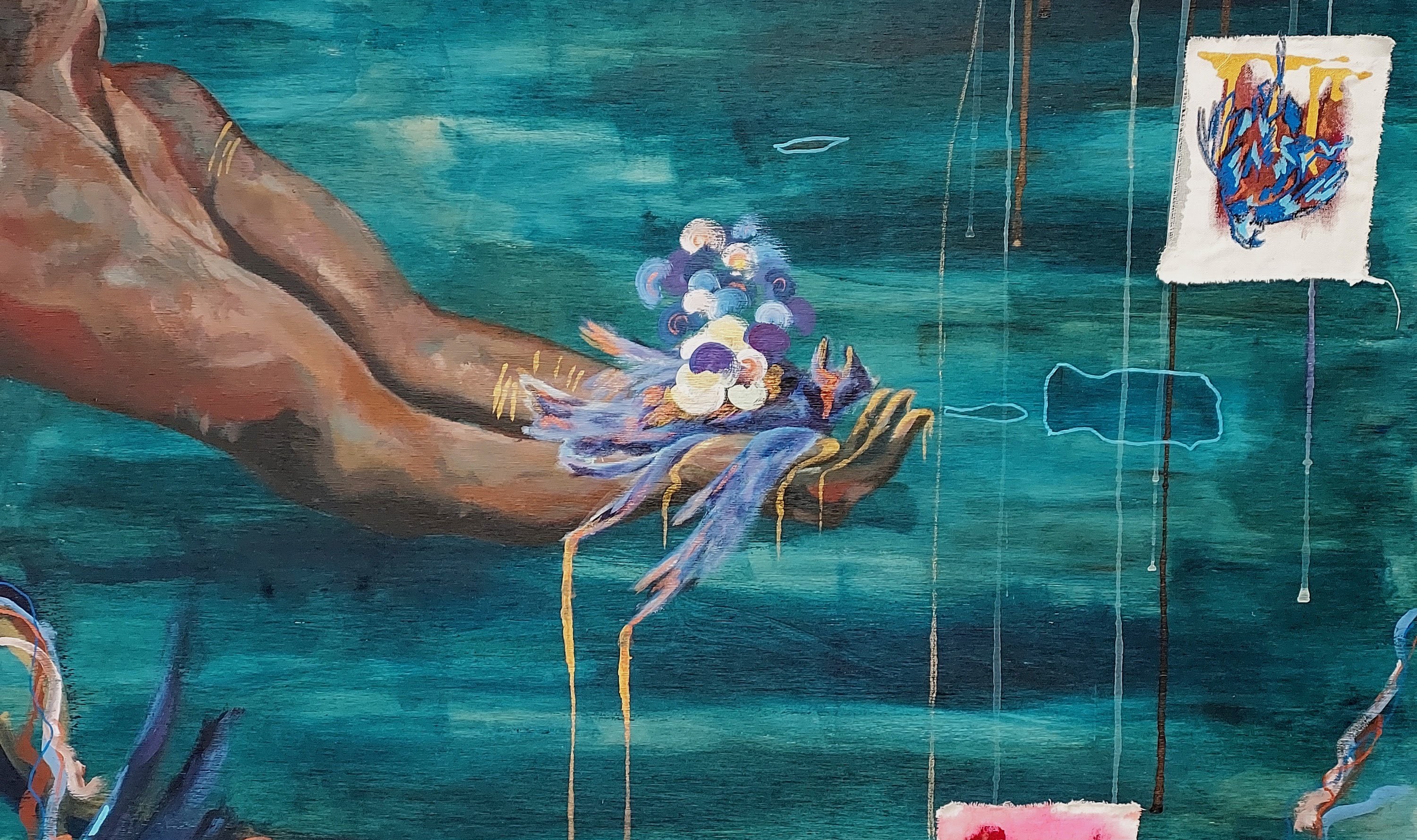
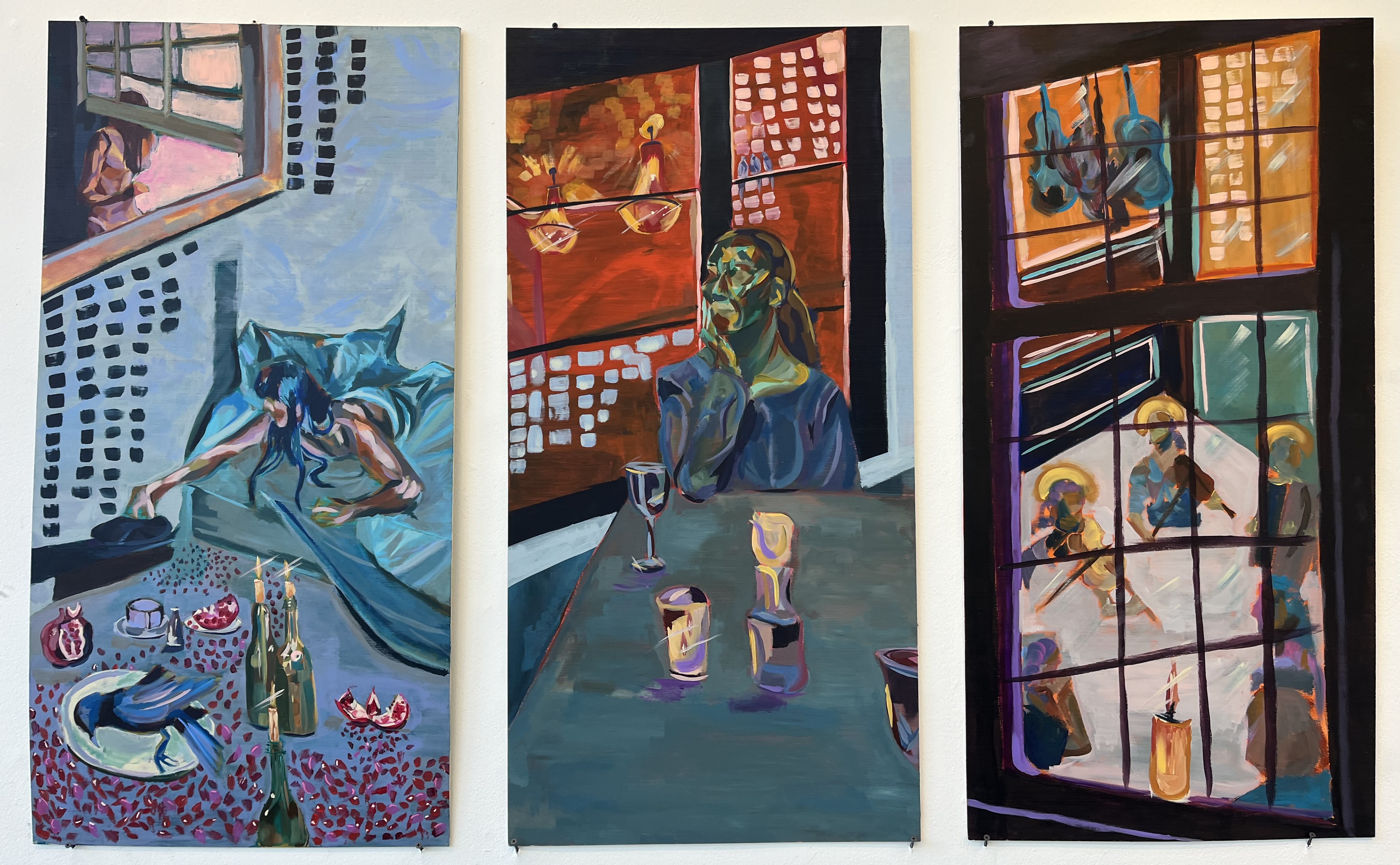
I’m thinking of the process of acrylic paint. The way I paint is a lot of layers on top of layers, and a lot of mixing. It’s sort of difficult to translate that into writing because they are two very different mediums. But when I’m thinking of the structure of stories, I think about them in terms of layers, and about how someone could read it this way and someone else could read it that way. So how do I paint something for both people to see. And sometimes I’ll be writing something and then have an idea for a painting and then go off with that.
Now that you mentioned family dynamics, that leads us to my next question. What themes or motifs do you often find yourself writing about?
I have a very big family. My dad’s side of the family is Trinidadian which is a very small island in the Caribbean. And my mom was adopted by my grandparents when she was a couple of months old. Both my grandparents served in the US Army and Navy respectively, when it was still segregated. So lots of different stories from families. I’m very, very close to my cousins. I’m very, very close with my siblings. I’m the oldest of three. I was talking to Lucas and Willow yesterday. We’re all very, very close.
And like I was saying, my parents are in education. My mom is an English professor, and she’s also a writer. We talk a lot about stories that we’re working on. My dad majored in American History. I’m very close with my grandparents, aunts, uncles. So a lot of family dynamics, especially between siblings because I think that’s very important to who I am as a person. I find that no matter what I do, [sibling dynamic] makes its way into whatever I’m working on.
I also like to think about nature and history. I mentioned birds. Birds always show up somewhere at some point. I found that transitions from in and out of childhood, and the ways we come back to childhood are things that I think about a lot. I also think about human identity, race, and gender — those are the big overarching ideas. But I do try to ground everything in interpersonal connections, and I find that [those connections] usually come in the form of sibling dynamics or parent-child dynamics.
I also noticed a huge presence of fruit in your work. Do you have any specific connection with fruit, or is it something that naturally came up?
Recently, yeah. I found that there are some motifs that I [notice] when I look back on things I’ve written throughout the years. Like, when I was in high school, there were a lot of street lamps. I don’t know why.
You mentioned the transition in and out of childhood. Your two pieces published in HIKA seem to be in conversation with each other in terms of the loss of innocence in a way too. Do you feel like that’s the case? And if so, can you expand on this?
I think about this a lot: the moment when something internal or external happens, and you suddenly start thinking of yourself in a different way. And nostalgia is something I think about a lot. I think all of us in some way or another are trying to get back to some childhood version of ourselves. I think the childhood versions of ourselves are some of the most authentic versions. That’s also one of the reasons why I go back to children’s books a lot. I think those are some of the most honest books you can find. And I think more people should read children’s books, no matter how old they are. But yeah, I think childhood is such a unique experience for each person, but at the same time, we never truly understand it because you’re always looking back on your childhood experience. So you never really understand it in the moment. You’re always looking back as an observer of your own childhood, of your own innocence.
That’s a lot of what “Half-Life “is about — this whole idea of, maybe it wasn’t easier when we were kids, but it was simpler. For me, at least, and I’m very fortunate to be able to say that. But some human connections are just easier when you’re not looking back on them. I think the relationship someone has with their parents as a child is very different than the relationship they have with parents as a teenager, or someone who’s now in college or beyond that. I mean, everyone’s changing every day, depending on who you talk to and who you interact with, so it’s all based in personhood, but I think childhood is a very interesting thing to me. I think that we’re all observers of our past lives.
Rent out your childhood body to remember the safety that came with the silence but your bones won’t fit anymore. They’re in a jar on a shelf in your grandparents’ old house.
— from “Half-Life”
It seems that both “Ciret Street” and “Half-Life” are written from the perspective of someone relatively young. Is the narrator looking back, or is the narrator experiencing the event as it is happening, full of mystery to her?
In terms of “Ciret Street,” I view it as someone looking back and trying to gain further understanding. But at the same time, you could read it as someone who is experiencing this in the moment. “Half-Life” is about me and my cousins, though not entirely accurate because it is me looking back on the moment when I was usually the first one who woke up after sleepovers, and we’re waiting to go down for breakfast. And like, looking back on that moment, it’s hard for Half-Life to be a piece in which the narrator is experiencing in real-time because I wrote that looking back on a real thing.
“Ciret Street” is fictional while “Half-Life” is creative nonfiction. Was the process for writing the two pieces different for you?
I find them very similar. I don’t tend to write a lot of creative nonfiction just because it’s not something that comes as naturally to me. “Half-Life” definitely took more time. I don’t tend to love writing about myself. I find that I’m always trying to make [my non-fiction pieces] fit whatever I think I should be portrayed as, and I don’t find that entirely honest. I find it easier to write fictional stories in which parts of myself or other people can be transmitted into it. I find that to be more authentic in a way.
I’ll mention the film piece at The Gund (Wooster Street) again. I thought that it was especially interesting that you were thrown into this discussion between the artist and the interviewer as if you already knew these people. You don’t really know them, but you’re seeing these images of their lives, and I found that to be a very interesting moment that was being portrayed. So I think about my fiction as that: someone reading it could see themselves in this character, and they’re almost thrown into [the story].
Looking forward, what are your writing aspirations?
I’m nineteen now. I met an author named Jason Reynolds, who is a black author that does a lot of work with young adult stories around race in America. He’s an incredible writer and an incredible person. I was fortunate enough to meet him last year when he came to visit our school. I had a conversation with him, and we talked about writing.
He asked me what I would want to have done by the time I was 25, and I said, I would like to have written a book by the time I’m 25. And he said, “Great I’ll look out for your book,” which is something. That started getting into my head: now I have a goal for something, which I didn’t really think about before.
I’ve always loved writing. I have a couple of things that I’m working on now. We’ll see how it goes. It might fall to pieces sometimes. Sometimes I’ll start writing something that I think is going to be longer, and then somewhere around the midpoint it just drops off. And a lot of the time I know the endings of things before I know what happens to lead up to the ending. So my goal for this summer is to get a draft done. It probably won’t be very good, but I mean, I forget who said this but someone said writing is rewriting.
 hika.
hika. 
Leave a comment