Otto’s two art pieces, “His Descent Was Like Nightfall” and “Girls’ Night” will be published in the 2024 issue of HIKA and appeared in the HIKA Fall Preview.
How would you categorize “His Descent Was Like Nightfall”?
Comic sounds kind of juvenile. So I guess maybe graphic novel? Graphic and poetry.
For that piece, what came first? The words or the art?
It was the words. I wrote that last year because I wanted to enter some scholarship stuff. And that classical type of stuff really inspires me. I love that kind of imagery, so I started making the art this year.
I’m really intrigued about the title. Can you tell me more about it?
In “Iliad,” which is where the story of Achilles and Patroclus comes from, in one of the translations that’s how they describe Achilles — his descent being like nightfall. And I thought that was interesting to pair with him going through this very tragic story and not having a happy ending at all. I thought that [the comparison] would be not only relevant to the text but also a gripping title.
From whose point of view did you write the piece?
I don’t really have a specific speaker in mind. It’s more like me thinking about the story of Patroclus and Achilles. Also, in the story, the mother has a big part: she dips Achilles into the river and he gets super powerful. And in the poem, I kind of blame his mom for everything he went through, for giving him that destiny of power and cursing him to be someone big.
What’s the medium that you are most drawn to?
I feel like I do poetry because it’s impressive. Like, you feel so full of yourself when you do poetry. So I think I’m more drawn to the art aspects. I definitely do more art. I’ve been doing painting, illustrating, and digital art for years. That’s more of what I do for fun, and poetry is more [of something that] I don’t really do for myself. I don’t really do poetry for myself; I do it as more of a reflection of what I’ve learned and how I can utilize the craft. It’s not an expression for me, which is bad.
Would you say that poetry for you is more intellectual while art is more expressive?
Yeah. That’s not good. Like, I’m not going to be a poet.
Is there anything that you want to experiment with within the two mediums that you are already working in, or any new medium that you want to try?
I want to do more with graphic novels. For graphic novels, the writing in them is more like poetry than it is in fiction. Because in prose, there’s so much description and so many extra words to get the visuals out, but the graphic part of the novel takes care of that. So we’re left with the bare bones of words that you need. And that’s where poetry comes in. So I think [the words and visual] work really well together. If I had time and energy, I’d want to explore that more.
How did the ideas for “His Descent Was Like Nightfall” and “Girls’ Night” come to be?
Last year I was going to apply for some scholarship competition, but I’m horrible at deadlines so I missed it. I couldn’t submit anything, so I just had a lot of art leftover that I was really passionate about. I still wanted to do something with them, and you’re supposed to have a theme for your whole portfolio. Both of the two works were a part of [the portfolio]. And [my theme] was Beauty and Monstrosity. Within “His Descent Was like Nightfall” there’s so much gore and tragedy in it. But also, one of the most revered pieces of literature, at least in Western literature, is the Iliad. And then “Girls’ Night” has a very different tone. For “Girls’ Night” — I love blasphemy. I just like the idea of a teenage girl locking the door of her room in a religious household and being best friends with the devil. I tried to include a lot of hidden religious imagery within the room, and I centered them on a seance circle. I like those clashing together.
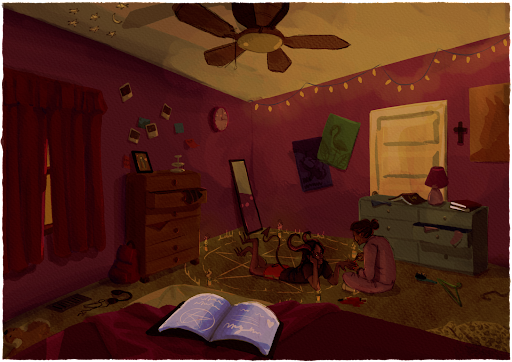
What themes and motifs do you consistently turn to in your work? You did mention Beauty and Monstrosity. You can talk more about those two themes, or open the discussion up for more.
[On Beauty and Montrosity] I think so many monsters in our literature and media — Frankenstein’s monster, for example — a lot of it is about misunderstanding. What are we basing our judgments on — I think it’s important to highlight that. I just love that — the ugliness of it all — and not needing to be appealing or attractive in any way. But there’s still deep complexity and beauty within [the ugliness].
How was the concept of Beauty and Monstrosity manifested in “His Descent Was Like Nightfall”?
In “Iliad”, Achilles is given power, and he has a prophecy for him that sets up [him killing] this many people and [him not being able] to escape it. And much of the story is about him grappling with that and not wanting to be that person. Finally, he becomes that person when the love of his life is murdered because of the war. The prophecy is fulfilled and in [His Descend Was Like Nightfall] I explore what causes someone to go down that path, and where the blame lies. Also, within Ancient Greece, there is always [the idea that] the gods are great; they’re perfect; they’re beautiful. But so many of the ancient strifes can be blamed on those perfect beings.
What artists and/or writers do you find yourself turning to for inspiration? How do they inspire your work?
I really like the classic, like the sonnets or old stuff that has way too many rules applied. I’m not the biggest fan of freeform poetry or things that play with form. I love playing with meters and metrical feet. I just feel like I use more creativity when there are more rules. Because then you have to think way more about it. Yeah, I love using the stuff that is considered to be the height of literature, or high-class poetry or whatever, and then using those forms to talk about not really high-class things.
Can you expand on that?
I think we revere past poets way too much. We put them on such a big pedestal. We think they’re so groundbreaking, so amazing, we could never be like them. That’s ridiculous. I think all of my English professors are going to come after me for this, but I just think that while yes, being the firsts of your time is very important and impactful and it takes a lot of creativity to do, I also think that a good number of them didn’t write very good poetry, and there were just less options to look at. I think if a lot of them wrote stuff now, we would not give it a second glance.
Okay but you did mention that you are inspired by old forms. So for inspiration, do you tend to look to the old masters or contemporary poets?
I don’t look at a lot of contemporary poetry at all. [ENGL 291] Asian American Poetry is probably my first exposure to modern stuff. But I love Robert Frost, and Shakespeare’s plays — the things that you know are good and enjoyable to hear, but unless you really dig into it, you can’t necessarily define why it’s good. There’s this mastery of the science of the human ear, and what stressed and unstressed [syllable] that will naturally make you more inclined to listen.
What’s your dream project to work on, given infinite time and resources?
I’m double majoring in English and Theater, and minoring in Music. I love musical theater. I think it is one of the greatest art forms, and I’d like to create a musical. There’s so much distance right now from [the current] me and the me who knows everything on how to do that — beautiful dialogue, beautiful storytelling, and then harmonies, and recurring bits of music that accentuate plot points. It’s great. It would be amazing to create something like that.
You are interested in many mediums. How do you feel that they influence each other in your creative work?
I have never thought about that before. Okay, I’m gonna get into some big stuff here. My family is very capitalistic, and very hardworking, and everything is toward a greater goal. I was talking to someone about this recently, and they thought I was so broken for it. But I can’t do things for fun. I said before about how I don’t do poetry as an expression. Everything I create — is with the thinking How is this going to look, How impressive will this be, which is bad. But I think everything I do is with the thought of This will look so cool, but not necessarily that this will be fulfilling to me or that it will be expressive. For me, it’s How will this leave a legacy? — I don’t know how I feel about that.
Do you want to be out of that mindset?
Yes, because I get in these downs sometimes when I haven’t done something that I’m proud of or that will further myself in some way. I will be like I’m wasting my time, or I’m not utilizing my time as best as I should, I should be doing something worthwhile, which probably isn’t good for my mental health. And it’s bad in general as an artist to be like that. Other artists — if they were stranded on a desert island with art supplies, they would still create. I don’t know if I would do that, which is, I don’t know, bad.
What are your creative aspirations for the future?
I want to make a musical. I want to write an illustrative graphic novel. And I’ve always wanted to make marble sculptures. That’s so hard, and costs so much money. So anything within the artistic world. I want to learn piano. I want to do all this stuff. It’s just the barrier of time and money and ambition and not being burnt out all the time. It’s rough.
 hika.
hika. 
Leave a comment